

Engraving machine
Precise marking is often a small step in the workflow, but it has a direct impact on traceability, part identification, and workshop organization. In toolrooms, maintenance areas, and light fabrication environments, the right engraving solution helps create clear, durable marks on metal and other hard surfaces without adding unnecessary complexity to the job.
Engraving machines in this category cover practical marking tools used for identification, lettering, and surface marking tasks. Depending on the application, users may need a pneumatic engraving pen for repetitive industrial work, an electric engraver for flexible bench use, or manual punch tools for straightforward permanent character marking.
Where engraving tools fit in industrial work
In many production and maintenance settings, engraved markings are used to identify components, label fixtures, mark ownership, or add reference codes during assembly and inspection. These marks can support internal quality control, maintenance history, or simple shop-floor organization where labels or stickers may not last.
For mold-related and metalworking environments, engraving is also part of a broader preparation and finishing workflow. Shops that handle specimen preparation or surface evaluation may also work with equipment such as sample cutting machines or grinding and metallographic polishing machines, making engraving a complementary step for sample identification and traceable handling.
Common types of engraving solutions in this category
This category is not limited to one single machine format. In practice, engraving and marking can be carried out with several tool styles, each suited to a different working method. Choosing the right option depends on the material, marking depth, production frequency, and operator preference.
Pneumatic engravers are typically selected when compressed air is available and users want a lightweight tool for repeated marking tasks. Electric engravers are often preferred for portable bench work or maintenance use, while letter punch sets provide a simple manual method for creating consistent characters without requiring power or air supply.
Representative products for marking and identification
A good example of a pneumatic solution is the AIRTEC 900 Engraving pen, which is designed for air-powered marking work. This type of tool is suitable for users looking for a compact engraver that can be integrated into workshop air systems and used for repetitive identification tasks on suitable surfaces. More AIRTEC options can be explored on the AIRTEC manufacturer page.
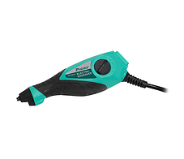
For users who need an electrically powered option, the Pro'skit PT-5203I Electric Engraver offers a practical approach to light engraving work. Electric engravers are often useful when mobility and straightforward setup matter more than connection to a compressed air line. If your work leans toward hand tools and electronics-related workshop equipment, the Proskit brand page provides additional context for related product lines.
Manual character marking remains relevant in many industrial environments, especially for fixed-size text and permanent stamping. The TOPTUL NGAW2706 Letter Punch Set is an example of a manual marking tool used when operators need clear letter impressions without relying on powered equipment.
How to choose the right engraving machine or marking tool
The first consideration is the marking method. If the job requires freehand marking, tracing, or flexible identification on varying parts, a pneumatic or electric engraver may be more suitable. If the requirement is uniform text with repeated character size, a letter punch set may be more practical and easier to standardize across operators.
Next, consider the working environment. Pneumatic tools make sense where compressed air is already part of the shop infrastructure, while electric engravers are easier to deploy in service areas, assembly benches, or smaller workshops. For occasional marking jobs, manual tools can be cost-effective and simple to maintain.
Material and finish requirements also matter. Some applications prioritize legibility over depth, while others need a more permanent mark that can remain visible after handling, cleaning, or surface treatment. In those cases, users should evaluate not only the tool type but also how the marked part will be used afterward in production, storage, or inspection.
Applications in mold, tooling, and maintenance environments
In mold and tooling work, engraving is commonly used to identify inserts, cavities, electrodes, holders, jigs, and maintenance-related components. Clear physical marking helps reduce mix-ups, especially when parts are visually similar or circulate between machining, fitting, and inspection stages.
Maintenance teams also use engraving tools to mark asset numbers, repair references, and internal tracking codes on tools or machine-related parts. In quality and lab-oriented workflows, engraving can support sample identification before or after preparation steps that may involve mounting machines, helping maintain traceability throughout handling and analysis.
What to consider beyond the tool itself
When selecting from an engraving category, buyers should also look at practical factors such as operating comfort, available utilities, expected duty cycle, and ease of use for technicians. A lightweight air engraver may reduce fatigue in repetitive work, while an electric model can simplify setup for users who move between workstations.
It is also useful to think about how engraving fits into the full process rather than treating it as an isolated purchase. If the shop already uses manual marking methods, adding an electric or pneumatic engraver may improve flexibility for custom markings. On the other hand, if the requirement is mostly fixed alphanumeric identification, manual punch tools may remain the more direct solution.
Choosing with the application in mind
There is no single engraving solution that fits every workshop. Some users need portable marking for maintenance tasks, others need repeated industrial engraving with compressed air, and some simply need dependable manual character marking for metal parts and tools.
This category brings together practical options for those different needs, from the AIRTEC 900 Engraving pen and Pro'skit PT-5203I Electric Engraver to the TOPTUL NGAW2706 Letter Punch Set. By matching the tool to the marking method, work environment, and traceability requirement, buyers can choose an engraving setup that supports day-to-day efficiency without overcomplicating the process.
-
-
-
-
-
-
-
-
-
-
-
-
-
-
-
-
-
-
-
-
-
-
-
-