

Length Measurement
Accurate dimensional control is a basic requirement in manufacturing, maintenance, calibration, and quality assurance. When parts must fit, align, seal, or move within a defined tolerance, reliable length measurement tools and services become essential for reducing errors and improving consistency across the production process.
This category brings together solutions used to verify linear dimensions, distances, thickness, depth, diameter-related features, and other size-dependent characteristics in technical environments. It is relevant for machine shops, industrial plants, laboratories, inspection departments, and service teams that need dependable measurement results for daily work or formal quality procedures.
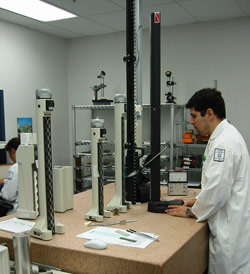
Why length measurement matters in industrial work
Dimensional accuracy affects product quality at nearly every stage of a process. From incoming material inspection to in-process checks and final verification, a small deviation in length or spacing can lead to assembly issues, higher scrap rates, or performance problems in the field.
In many applications, measurement is not only about confirming a nominal size. It also supports process capability, preventive maintenance, tooling verification, and traceability. For businesses working under quality systems, dependable dimensional inspection helps create confidence in both production output and documented compliance.
Typical applications for length measurement
Length-related measurement is used across a wide range of industries, including machining, metal fabrication, electronics production, automotive supply, packaging, plastics, and general industrial maintenance. The exact method depends on the workpiece geometry, the required tolerance, and whether the check is performed on the shop floor or in a controlled inspection area.
Common tasks include measuring part length, step height, thickness, hole spacing, external dimensions, internal features, and relative position between critical points. In service and calibration environments, these measurements also help verify whether equipment, fixtures, and finished components continue to meet operational requirements over time.
Choosing the right solution for the measurement task
Selecting the right approach starts with the application rather than the instrument name. Users typically need to define the measurement range, expected tolerance, contact or non-contact method, environmental conditions, material type, and the level of repeatability required for decision-making.
Another important factor is where the measurement takes place. Shop-floor use may require robust equipment that can handle vibration, dust, and fast inspection cycles, while laboratory work often prioritizes higher resolution, stable conditions, and formal calibration control. The best choice is usually the one that balances accuracy, repeatability, and usability for the real working environment.
Key considerations in quality control and calibration
Reliable results depend on more than the measuring device itself. Surface condition, operator technique, temperature variation, part cleanliness, fixturing, and measurement force can all influence the outcome. This is why consistent procedures are just as important as the specification of the instrument being used.
Calibration and periodic verification are also central to measurement confidence. Organizations that manage multiple inspection points often need a structured approach to instrument status, reference standards, and measurement records. In broader quality systems, length-related checks are commonly used together with optical measurement methods when visual or non-contact verification is required.
Length measurement within a wider inspection workflow
Dimensional control rarely stands alone. In practical production settings, engineers and technicians often combine linear measurement with other inspection disciplines to understand the full condition of a part, assembly, or process. This helps identify whether a problem comes from size variation, material changes, pressure conditions, or mechanical load.
For that reason, this category is often relevant alongside mass measurement, pressure measurement, and surface and force-related measurement requirements. Looking at the complete inspection chain can improve root-cause analysis and make process improvements more effective.
What buyers and engineering teams usually look for
B2B buyers are typically not searching for a generic measuring tool. They need a solution that fits a specific technical workflow, documentation requirement, or inspection standard inside their organization. That may include compatibility with existing procedures, ease of operator training, calibration support, or suitability for repetitive checks on similar parts.
Engineering and quality teams also evaluate long-term practicality. Questions such as measurement stability, maintenance needs, handling convenience, and integration into broader quality routines often matter as much as the basic measurement range. A well-matched solution can improve throughput and reduce uncertainty without adding unnecessary complexity.
How to evaluate length measurement needs before ordering
Before selecting from this category, it is useful to define the main measurement objective clearly. Consider what feature must be measured, how often the inspection will be performed, what tolerance must be confirmed, and whether the result is used for process adjustment, final acceptance, or traceable reporting.
It is also helpful to review the measurement environment and operator workflow in advance. A practical evaluation often prevents over-specifying equipment for simple checks or under-specifying it for high-precision work. If your inspection needs extend across several parameters, related categories such as optical systems or other measurement groups may provide a better fit for mixed applications.
Supporting consistent results across production and inspection
This category is intended for organizations that need clear, dependable methods for measuring size-related features in technical settings. Whether the priority is incoming inspection, in-process control, maintenance verification, or formal quality documentation, the right length measurement solution helps create more stable decisions and fewer avoidable errors.
By aligning the measuring method with the actual tolerance, environment, and inspection workflow, teams can improve both efficiency and confidence in the final result. If your process involves multiple measurement disciplines, exploring the related categories can also help build a more complete and practical inspection system.
-
-
-
-
-
-
-
-
-
-
-
-
-
-
-
-
-
-
-
-
-
-
-
-