

Tools
From fabrication and maintenance to installation and finishing work, the right tool selection has a direct impact on productivity, surface quality, and jobsite safety. This category brings together a broad range of Tools for industrial users, workshops, technical service teams, and B2B buyers who need dependable equipment for daily operation rather than one-off use.
Within this product group, buyers typically look for a practical mix of power tools, consumables, and task-specific accessories that support drilling, cutting, grinding, sanding, chiseling, and material preparation. The portfolio shown here is especially relevant for metalworking, construction, repair work, and general plant maintenance, where tool compatibility and application fit matter as much as brand preference.
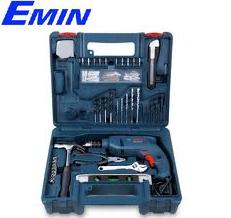
Built for day-to-day industrial applications
In technical purchasing, tools are rarely evaluated in isolation. Buyers usually need to consider the full workflow: making a hole, enlarging or shaping a surface, cutting material to size, removing stock, then preparing the finish. That is why this category is useful not just for sourcing individual items, but for identifying a more complete working setup around a specific task.
The current range highlights both handheld equipment and supporting consumables. Examples include drilling tools such as the BOSCH HSS-CO Drill bit (4mm), cutting and grinding consumables like the BOSCH A 30 R BF Cutting Disc (125 x 3 x 22.2mm) and BOSCH 2608600017 Iron Grinding Wheel (100x6x16mm), as well as finishing products such as the 3M P120 Abrasive Disc and 3M P800 Abrasive Disc. For teams standardizing by supplier, it is also useful to explore the wider BOSCH product range or available solutions from 3M.
Typical product groups within this category
A practical tools category usually serves multiple stages of work. Power tools handle the main mechanical operation, while discs, bits, and abrasives act as the process interface with the material. For buyers, this means product choice should reflect not only the tool body but also the wear parts and accessories required for continuous operation.
Representative power tools in this selection include the BOSCH GWS 2200-180 Angle Grinder (8,500rpm), BOSCH GEX 125-1 AE Orbital Sander Random (250W), BOSCH GHO6500 Planer, BOSCH GBH 2-26 DRE Rotary Hammer (800W), and BOSCH GBH 8-45 D Rotary Hammer. Supporting items such as cutting discs, grinding wheels, drill bits, and pointed chisels help complete the system. The BOSCH 2608684884 pointed chisel, for example, fits the broader need for demolition or material removal work when rotary hammer tools are used for more than just drilling.
How to choose tools for the job
The most effective way to narrow down options is to start with the application rather than the product name. For drilling, the workpiece material and required hole diameter are key. For cutting and grinding, buyers should check disc diameter, bore size, thickness, and the intended material. For sanding or surface preparation, grit level and pad size influence both removal rate and final finish.
Power rating and speed also matter, but only in context. A larger angle grinder such as the BOSCH GWS 2200-180 is relevant where heavier cutting or grinding capacity is needed, while an orbital sander like the BOSCH GEX 125-1 AE is better suited for controlled finishing and surface refinement. For masonry and concrete work, the decision often shifts toward rotary hammers, where impact energy and drilling range become more important than plain rotational speed.
Matching consumables with the base tool
One common source of downtime is using mismatched consumables. Disc size, spindle thread, mounting dimensions, and application type should always align with the tool and the target material. A cutting disc designed for metal cutting serves a different function from a grinding wheel, even when the diameter looks similar at first glance.
This is why product details such as 100 x 1.2 x 16 mm or 125 x 3 x 22.2 mm are operationally important. Thin cutting discs are generally selected for efficient cutting with reduced material loss, while thicker grinding wheels are intended for edge dressing, deburring, or stock removal. Abrasive discs such as 3M P120 and 3M P800 are also chosen based on process stage: a coarser grit for earlier material removal, and a finer grit for more refined finishing work.
Common use cases across maintenance and production
In maintenance departments, tools in this category are often used for corrective work, replacement jobs, structural modification, and routine workshop preparation. A drill bit may be needed for fixture mounting, a cutting disc for trimming steel sections, and a grinder for weld cleanup or edge preparation before the next process step.
In fabrication and construction environments, material-specific tool selection becomes even more important. Rotary hammers are commonly chosen for concrete and masonry, while planers are used where timber surfaces or dimensional adjustment are part of the task. Sanders and abrasive discs support finishing quality, especially where paint preparation, smoothing, or controlled surface correction is required.
Why brand consistency can matter in B2B purchasing
For many companies, selecting tools from a known manufacturer helps simplify after-sales support, operator familiarity, and replacement sourcing. BOSCH appears prominently in this category with a strong mix of power tools and consumables, which can be useful for businesses seeking a more unified supply base. 3M, on the other hand, is well represented in abrasive products that support sanding and finishing processes.
That said, the best purchasing decision still depends on the operating requirement. A standardized brand strategy may help with procurement efficiency, but the actual fit between tool, accessory, and material remains the more important factor. Buyers comparing alternatives may also review other industrial suppliers such as ABB or BAHCO where relevant to broader maintenance and tooling needs.
What technical buyers should review before ordering
Before placing an order, it is worth checking a few practical points: operating environment, frequency of use, material type, dimensional compatibility, and whether the item is a primary tool or a consumable. This helps avoid common purchasing errors such as ordering the correct disc type in the wrong size, or selecting a tool with insufficient capacity for the intended duty cycle.
It is also useful to think in terms of the full work package. A rotary hammer may require matching chisels or drill bits, while a sander may need the correct abrasive grade for each finishing stage. Looking at tools this way supports better stock planning, fewer interruptions on site, and smoother coordination between maintenance, engineering, and procurement teams.
Supporting a more efficient tool selection process
This category is designed to help industrial buyers source from a practical cross-section of tools used in real working environments, from drilling and demolition to cutting, grinding, sanding, and surface preparation. Instead of treating every item as a standalone purchase, it is more effective to evaluate how each tool fits into the wider job sequence and the materials being handled.
Whether the requirement is a rotary hammer for concrete work, an angle grinder for metal processing, a planer for timber adjustment, or abrasive discs for finishing, a clear understanding of application and compatibility will lead to a more reliable shortlist. That approach makes this tools range more useful for both one-time project purchasing and ongoing MRO supply planning.
Types of Tools (34,463.000)
- Assembly Tools (24,071.000)
- Bearing tools (560.000)
- Pneumatic Tools (2,172.000)
- Power hand tool (4,839.000)
- Refrigeration gas detector (HVAC) (274.000)
- Soldering, remove, assemble electronic circuit, SMT (2,672.000)
-
-
-
-
-
-
-
-
-
-
-
-
-
-
-
-
-
-
-
-
-
-
-
-